
How to Begin an Architecture Design Thesis
For most architecture students, the most difficult part of beginning a thesis is not the design. It is deciding what the thesis is actually about.
The problem usually begins with the word topic. A student feels compelled to find something large, important and suitably architectural: sustainability, vernacular architecture, housing, heritage, biomimicry, adaptive reuse, smart cities, public space. These are useful fields of interest, but they are not yet thesis topics.
A thesis begins when a broad interest starts producing a more precise question.
The process is less about finding the perfect subject at the outset and more about narrowing, testing, reading, discarding and reformulating until the subject becomes small enough to investigate seriously—and rich enough to design around. Research is rarely a single act. It involves searching, examining, testing, comparing, verifying, questioning and trying things out.
1. Begin With an Interest
Start with something you are genuinely curious about.
This sounds obvious, but it matters. A design thesis will occupy a substantial part of your academic year. You will read about it, argue about it, draw it repeatedly, question your assumptions and, eventually, spend far too many nights staring at it. Curiosity is therefore not a luxury. It is one of the few things that will keep the work alive when enthusiasm begins to fade.
The initial field can be broad:
- housing
- adaptive reuse
- sustainability
- informal settlements
- craft
- mobility
- public space
- conservation
- healthcare
- education
- vernacular architecture
- ritual
- ecology
- technology
At this stage, do not worry too much about arriving at a thesis title. Instead, ask what part of the subject attracts you.
You can begin narrowing the field by:
- geographic area;
- culture or sub-culture;
- timeframe;
- discipline or speciality;
- climatic region;
- building type;
- demographic group;
- material or construction system;
- social or economic condition.
A broad interest becomes useful only after boundaries begin to appear.
“Vernacular architecture” is too large.
“Courtyard housing in hot-dry regions” is better.
“Passive cooling strategies in courtyard houses of western India” is more manageable.
But even that is not yet a thesis.
2. Find the Problem Inside the Interest
A good thesis usually begins with some form of friction.
Something does not quite fit. Something is being overlooked. A familiar assumption seems too easy. A building type no longer works as expected. An old technique appears relevant to a new problem. A policy produces an unintended spatial consequence. A community occupies space differently from the way architects normally represent it.
In other words, ask:
What bothers me here?
Or:
What do I not yet understand?
This is the difference between a subject and a research problem.
A student interested in vernacular architecture may simply admire it. That is not enough. But perhaps the student notices that contemporary resorts borrow vernacular forms—pitched roofs, stone walls, courtyards—while depending almost entirely on mechanical cooling.
Now there is a problem.
The question is no longer:
How can I design a vernacular resort?
It becomes:
Why are vernacular climatic strategies so often reduced to visual motifs in contemporary resort architecture?
That question can lead somewhere.
A thesis worth pursuing usually contains a tension of this kind.
3. Make a Working List of Keywords
Once the area of interest and the initial problem become clearer, make a list of useful keywords.
The purpose of keywords is not merely to help you search online. They allow you to see which ideas repeatedly occur around your topic, and which connections might be worth investigating.
For example:
Initial interest:
Vernacular architecture
Possible keywords:
thermal comfort, courtyard, passive cooling, hot-dry climate, local material, adaptive reuse, resort architecture, regionalism, thermal mass, ventilation
As you read, this list should change.
Some terms will turn out to be too broad. Others will prove irrelevant. New words will appear that lead into more specialised literature.
This is useful.
Research is not simply a process of collecting information about a topic you have already fixed. The information should be changing the way you understand the topic itself.
4. Turn the Problem Into a Research Question
A thesis becomes much easier to manage once the subject can be expressed as a question.
The question should be specific enough that you can imagine what evidence might help answer it, but open enough that the answer is not already embedded within it.
For example:
IDEAS:
Vernacular architecture, sustainability, nature resorts
BROAD QUESTION:
Can vernacular architecture offer useful lessons for sustainable resort design?
FOCUSED QUESTION:
Which passive cooling strategies used in selected courtyard buildings in hot-dry regions remain effective under contemporary construction and occupancy conditions?
DESIGN THESIS QUESTION:
How can those tested climatic strategies inform the design of a contemporary nature resort in a comparable climatic region?
Notice what has happened.
The thesis has moved from a style—“vernacular architecture”—towards a relationship that can actually be investigated.
That distinction is important.
A weak thesis often begins with a building it wants to design and then searches for research that will justify it.
A stronger thesis begins with a question and allows the eventual building to emerge from the investigation.
5. Read Until the Question Changes
Now research begins in earnest.
Use your keywords to find books, academic papers, theses, case studies, measured drawings, technical reports and documented buildings. Where appropriate, this can be supplemented with field visits, interviews, surveys, environmental measurements or archival material.
But do not read simply to accumulate references.
Read to make the question better.
You may discover that somebody has already answered it.
Good.
You may discover that one of your assumptions was wrong.
Even better.
You may find that the subject you thought was central is actually peripheral, while something you barely noticed at the beginning becomes the real thesis.
This is exactly what research is supposed to do.
If the research question remains completely unchanged after substantial reading, it is worth asking whether the research is actually challenging your initial assumptions.
A thesis question is a working instrument, not a contract signed on the first day.
6. Check Whether the Question Is Researchable
Interest alone does not make a feasible thesis.
Before committing fully, ask whether you can actually obtain the evidence needed to investigate the question.
Do you have access to the buildings?
Can you obtain drawings?
Can you conduct interviews?
Are reliable sources available?
Does the subject depend on information that is inaccessible, proprietary or too expensive to collect?
Can the work reasonably be completed within an academic semester or year?
Do you have access to a mentor who understands the area?
A fascinating question that cannot be investigated is not yet a useful thesis question.
Scope matters here too.
Students often assume that a larger thesis sounds more important. Usually the opposite is true. A narrow question examined carefully is far more convincing than an enormous subject treated superficially.
Interdisciplinary research is not itself a problem. Uncontrolled scope is.
7. Use Design to Test the Research
An architecture thesis has one important advantage over many other forms of academic research:
you can test an argument through design.
The design need not merely illustrate what the written research has already concluded. It can become another method of investigation.
If your research suggests that certain courtyard proportions improve thermal performance, what happens when you apply them to a contemporary programme?
If an inherited settlement pattern depends upon incremental growth, can you design a housing system that allows genuine increment rather than merely appearing informal?
If your study concerns public and private thresholds, what happens when those relationships are translated into plan, section, circulation and material?
Design becomes useful when it forces the research into spatial consequences.
An idea that sounds convincing in prose may fail the moment it encounters a site, structure, budget, climate, programme or human body.
That failure is valuable.
It tells you something.
The design should therefore not simply answer:
What building can I make from this research?
It should also ask:
What can designing this building reveal that the research has not yet told me?
This is where an architecture thesis becomes more than a research paper with a project attached to it.
8. Keep a Record of How Your Thinking Changes
From the beginning, keep structured notes.
Do not merely collect quotations and images.
Record:
- the source;
- the claim being made;
- useful evidence;
- questions it raises;
- contradictions with other sources;
- your own observations;
- possible design implications;
- things you are unsure about;
- ideas that have changed since the previous week.
This becomes extraordinarily useful later.
By the time students begin writing the dissertation, they often remember the conclusion but forget how they arrived there. A good research notebook preserves the path.
It also helps distinguish three different things which easily become mixed together:
what the source says;
what you observed;
what you inferred.
Keeping those separate will make the eventual dissertation considerably stronger.
9. What Makes a Thesis Worth Designing?
Before finalising the topic, ask yourself a few simple questions.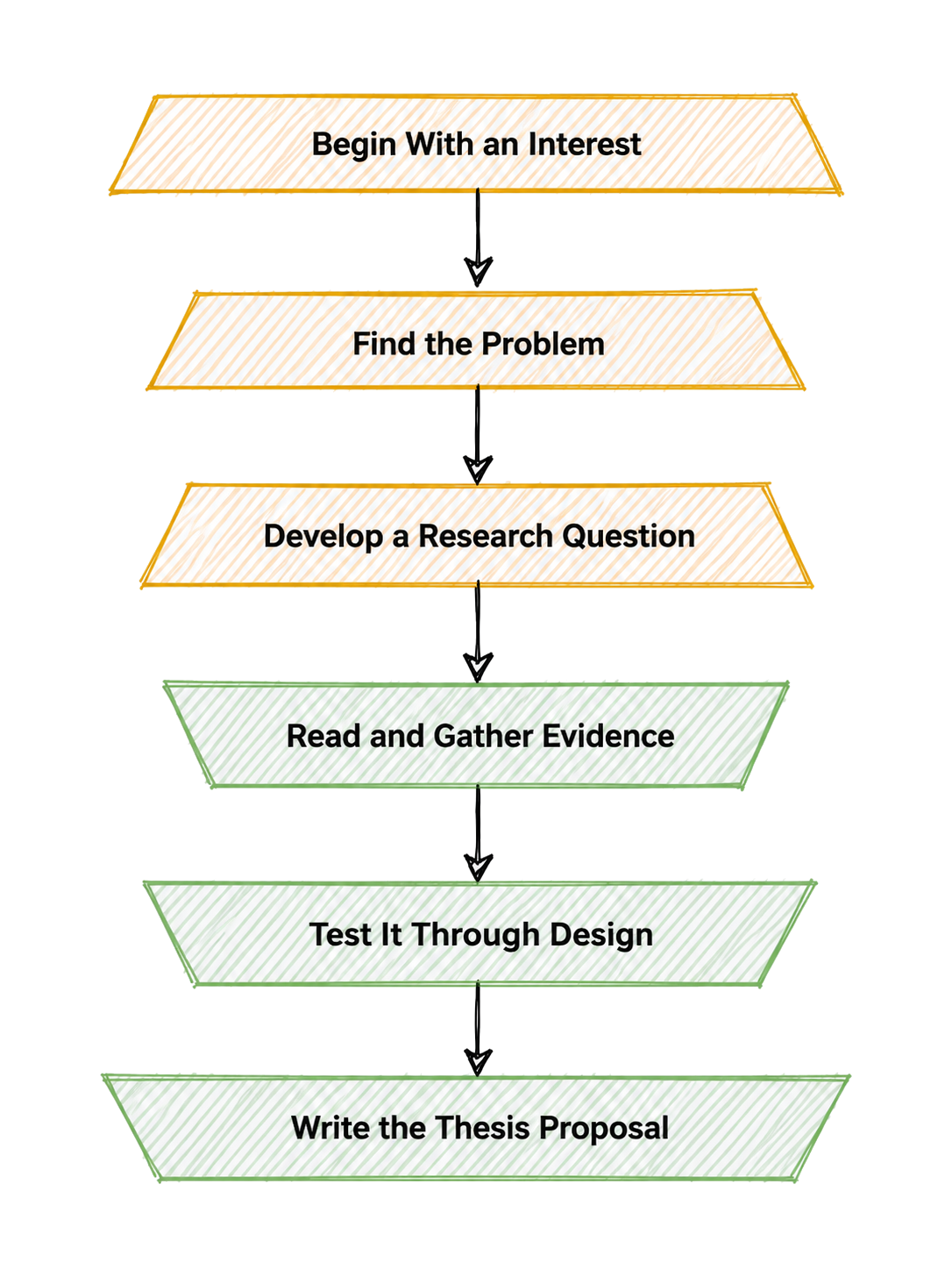 From interest to question to design — a simple sequence for beginning an architecture design thesis.
- Do I actually care about this question?
- Can I explain the problem without using a page of jargon?
- Is the question narrow enough to investigate properly?
- Can I obtain credible evidence?
- Is there genuine uncertainty, or do I already know the answer I want?
- Can architecture contribute something to the investigation?
- Can the design test the argument rather than merely represent it?
And perhaps most importantly:
Will I still want to know the answer six months from now?
A thesis does not need to solve an enormous problem.
It needs to ask a worthwhile question carefully.
The title can come later.
The project can come later.
Begin with the thing you cannot quite explain—and make the question small enough that architecture can help you find out.
